Stitched vs Sublimation Jersey: Which Is Better for Your Team?
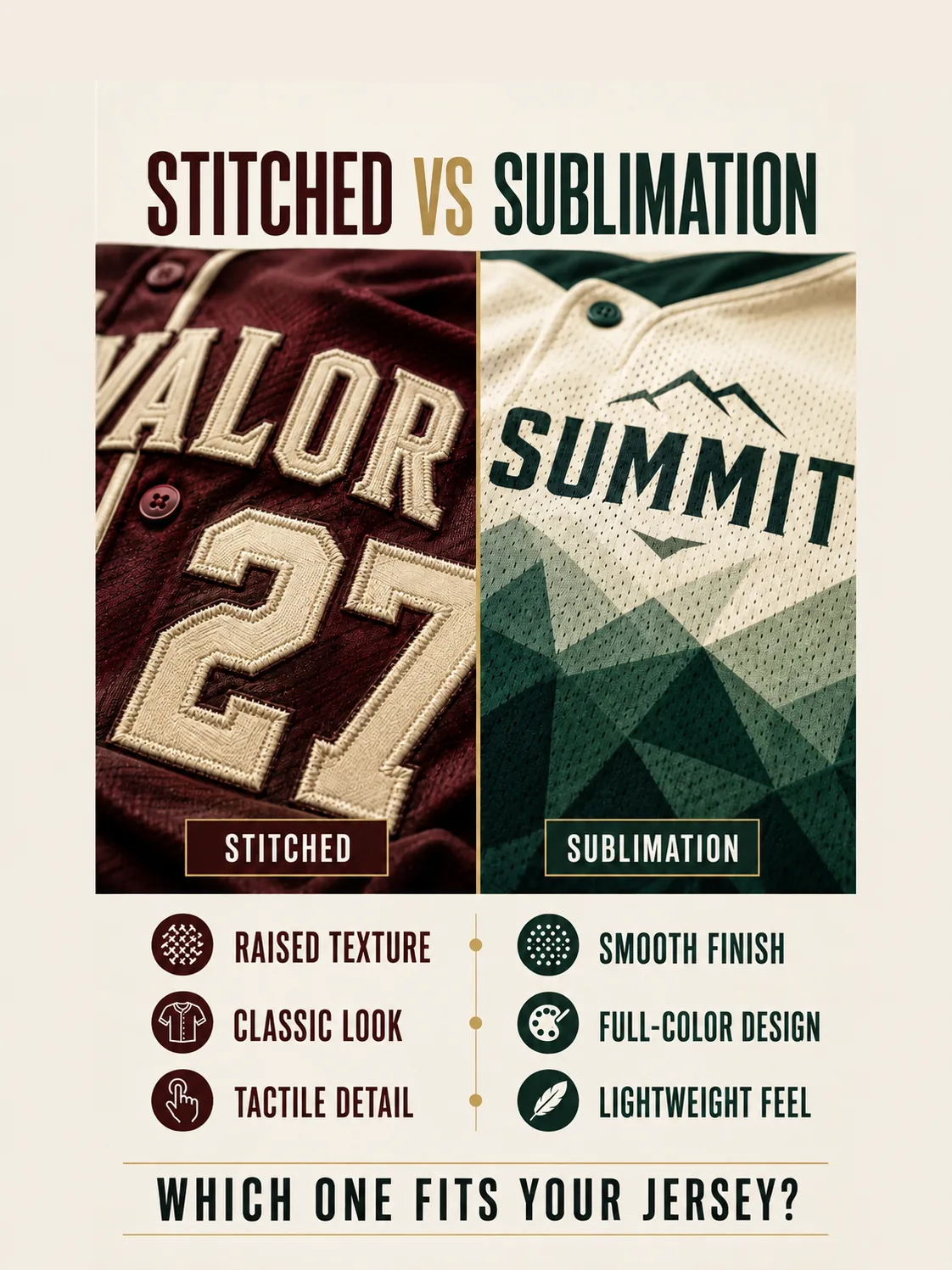
Trying to decide between a stitched jersey and a sublimation jersey? The two methods look similar in photos, feel very different in person, and serve completely different needs. This guide breaks it all down — no jargon, no guesswork.
What Is Sublimation Printing?
Sublimation — short for dye-sublimation — is a jersey printing process where heat and pressure convert solid dye into a gas that bonds directly with polyester fibers. The result: the ink does not sit on top of the fabric. It becomes part of it.
For jerseys, this means full-color, all-over designs — gradients, fine text, complex patterns — printed at once, at a consistent cost regardless of how many colors you use. Once printed, the fabric feels identical to an unprinted blank. There is no texture bump, no rubbery layer, nothing to catch and peel.
Key point: Sublimation is a dye process, not an ink-on-surface process. The color lives in the fiber. That is why sublimation jerseys cannot crack, peel, or fade the way heat-transfer or screen-printed jerseys can.
What fabric does sublimation work on?
Sublimation requires 100% polyester fabric in white or light colors. The dye bonds to synthetic fibers; on cotton or dark fabric, the print appears washed-out or invisible. Performance jerseys are almost always lightweight polyester — making sublimation a natural technical match for team sportswear.
What Is a Stitched (Embroidered) Jersey?
A "stitched" jersey refers to embroidery — thread sewn directly into the fabric using a commercial machine. The result is a raised, three-dimensional logo or lettering you can feel with your fingers. Understanding these distinctions helps you ask the right questions when comparing embroidery jersey options with modern jersey printing methods.
You will also hear tackle twill and appliqué used alongside "stitched." These techniques involve pre-cut fabric pieces — letters or numbers — sewn or bonded onto the jersey. Common in vintage varsity and throwback styles. The distinction:
- Embroidery: thread sewn into the base fabric. Best for logos and badges up to about 5 inches.
- Tackle twill / appliqué: pre-cut fabric shapes sewn on. Used for large player numbers, producing a thick, layered look.
Both methods create visible, tactile decoration. They signal craftsmanship and premium quality in a way a flat-printed jersey does not.
Important limitation: Embroidery cannot reproduce fine gradients, photographic images, or small intricate details. If your logo has more than 6–8 colors or thin strokes under 2mm, it needs simplifying for embroidery — or you need sublimation instead.
Head-to-Head Comparison
- Design freedom. Sublimation: unlimited colors & gradients. Stitched: limited — no gradients.
- Fabric hand. Sublimation: smooth, identical to unprinted. Stitched: raised, textured — premium feel.
- Durability. Sublimation: ink in fiber — can't crack. Stitched: thread won't fade.
- Weight added. Sublimation: none — ideal for sport. Stitched: slight stiffness at deco area.
- Cost vs color count. Sublimation: same price for 1 or 20 colors. Stitched: more colors = higher cost.
- Best fabric. Sublimation: 100% polyester, light colors. Stitched: any fabric, any color.
- Minimum order. Sublimation: as low as 1 piece. Stitched: also 1 piece — some suppliers add a setup fee for embroidery, though Mowment does not charge one at any quantity.
- Best for. Sublimation: competition uniforms, full-color team sets. Stitched: premium fan gear, branded apparel.
Durability: Which Lasts Longer?
Both methods are durable — but they age differently.
Sublimation durability
Because the dye is infused into the fiber at a molecular level, sublimation prints are essentially permanent. They will not crack, bubble, peel, or fade under normal washing conditions. The jersey may eventually thin out from mechanical wear, but the color will outlast the fabric itself. This makes sublimation the go-to choice for jerseys worn frequently in practice and competition.
Embroidery durability
Thread does not fade. The color is real yarn sewn into the fabric, not ink sitting on the surface, so there is no pigment to wash out or lighten over time. The risk is thread snagging or unraveling at the edges — particularly on jerseys subjected to heavy contact sport or improper washing. Turning the garment inside out before washing significantly reduces this risk.
Bottom line: For active athletic use, sublimation has the edge — nothing to snag or peel. For display-quality or collectible jerseys, embroidery holds its structure and visual impact over decades.
Cost Breakdown: Sublimation vs Stitched Jersey
Understanding jersey printing costs upfront prevents budget surprises. Cost depends on design complexity, quantity, and decoration area — here is how the two methods typically compare:
Sublimation cost structure
- Color count does not affect price. A 16-color gradient costs the same to print as a 2-color wordmark.
- No per-color plate or screen charge. Once your file is press-ready, setup is minimal.
- Per-unit cost scales well. There is no setup fee at Mowment at any quantity, and team pricing starts early — 5% off from 2 pieces, 10% off from 5, and 15% off from 10.
- All-over designs are cost-neutral. Printing the full jersey body costs effectively the same as a small chest logo.
Embroidery / stitched cost structure
- Digitizing. Your artwork has to be converted into a stitch file before it can be embroidered. Across the industry this is usually billed as a one-time setup charge per design; at Mowment it is included in the listed price, at any quantity.
- Stitch count drives unit cost. A large, dense logo costs more per piece than a small left-chest badge.
- Volume still helps. Larger runs reach Mowment's team pricing tiers, so the per-piece cost comes down as the order grows.
- Not efficient for large areas. Embroidering the full front of a jersey would be prohibitively expensive and impractically stiff.
Rule of thumb: If your design covers more than a 5×5 inch area, or uses more than 6 colors, sublimation will almost always be more cost-effective. Embroidery wins for small, simple logos where the raised texture justifies the premium.
Which Method Is Right for You?
Use this decision flow to find your answer:
- Are you ordering jerseys for a sport team worn in competition? → Sublimation. Lightweight, sweat-resistant, full design freedom for names, numbers, and logos at once.
- Do you want a premium fan jersey, collectible, or gift item? → Stitched / embroidery. The raised texture signals quality and collectibility that sublimation cannot replicate.
- Does your design include gradients, photos, or more than 6 colors? → Sublimation. Embroidery cannot reproduce these — your design will be compromised if forced into stitching.
- Does each person need their own name and number? → Sublimation. Individual personalization per piece is straightforward; embroidery requires a separate machine run per variation.
- Are you ordering corporate branded apparel or staff outerwear? → Embroidery. The industry standard for branded workwear — durability and professional appearance justify the cost for garments worn less frequently.
At a Glance — Who Each Method Is For
Choose Sublimation
- Coach ordering team uniforms
- School or club with a complex logo or crest
- Full-color sets with different names/numbers per player
- Family reunion or group event jerseys
- Small brand or creator launching a jersey run
- Multi-color design on a tight budget
Choose Stitched
- Collector jersey or premium fan gift
- Branded staff or corporate apparel
- Simple logo (under 5 colors, no gradient)
- High-end, artisanal look and feel
- Adding a small branded patch to an existing garment
What About Heat Transfer and Appliqué?
Sublimation and embroidery are the two most common methods, but not the only ones. Here is a quick overview of two others you may encounter:
Heat Transfer / DTF (Direct-to-Film)
DTF prints a design onto a film carrier, then bonds it to the fabric with heat and pressure. Modern DTF transfers produce vibrant colors on almost any fabric — including dark fabrics and cotton — making them more versatile than sublimation. The trade-off is a thin film layer you can feel. Durability has improved dramatically but generally falls below sublimation for heavy-use athletic wear. Best for: short runs, complex multi-color logos on cotton or dark garments, or adding names and numbers to pre-made jerseys.
Tackle Twill / Appliqué
Tackle twill uses pre-cut pieces of heavy twill fabric sewn or heat-bonded onto the jersey. It is the classic technique for large player numbers on throwback and varsity-style jerseys. The multi-layer dimensional effect is unmistakable and extremely durable. The downside: labor-intensive, adds significant weight, and is impractical for small text or complex logos. Best for: retro aesthetics, large player numbers, and statement lettering on premium fan gear.
Not sure which method fits your project? At Mowment we help you choose before anything is printed — no commitment required. A mockup proof is free if you ask for one. Get a quote for your team →
Frequently Asked Questions
What is the difference between stitched and sublimation jerseys?
Stitched jerseys use physical thread sewn into the fabric to create raised, tactile logos or lettering. Sublimation jerseys use heat and pressure to bond dye directly into polyester fibers — the ink becomes part of the fabric, not a layer on top. Sublimation allows unlimited colors, gradients, and all-over designs; embroidery offers a premium raised texture but is limited to simpler artwork.
Are sublimation jerseys durable?
Yes. Because the dye penetrates the polyester fiber at a molecular level, sublimation prints cannot crack, peel, or fade under normal washing and wear. The color is essentially permanent — it will outlast the fabric itself.
Which is cheaper — stitched or sublimation jerseys?
For complex, multi-color designs or all-over printing, sublimation is almost always more cost-effective. The color count does not affect sublimation pricing. Embroidery pricing scales with design size and stitch count, and most suppliers add a one-time digitizing charge — Mowment does not. For small, simple logos, embroidery can be comparable in price.
Can you embroider a sublimation jersey?
Yes — some premium jerseys combine both methods: sublimation for the main body design and embroidery for a small logo or badge. This hybrid approach is popular for high-end fan jerseys and corporate sportswear. It adds cost and lead time, so discuss it with your supplier before committing.
Do sublimation jerseys feel different from stitched jerseys?
Yes. A sublimation jersey is smooth and lightweight — the fabric hand feels identical whether printed or not, ideal for athletic movement. A stitched jersey has a raised, textured decoration area that adds slight weight and stiffness — a desirable quality signal for collectible or branded apparel, less ideal for high-intensity sport.
What fabric works with sublimation printing?
Sublimation works best on white or light-colored 100% polyester fabric. The heat-activated dye only bonds to synthetic fibers. On cotton, the print will appear washed out. Most performance jerseys are already polyester, making sublimation the natural match for team sportswear.
How long does it take to get custom sublimation jerseys?
Production and shipping are counted separately: 5–10 business days processing, then 7–10 business days shipping, from the day you order. If you would like to see a mockup proof first, ask for one free in the Order note box at checkout — we send it within 24–48 hours, and the processing time is then counted from your approval date instead. If you do not ask for a proof, we start production as soon as your design is prepared. Plan for extra lead time during Q4 (October–December) when team and holiday orders peak.
Can I order just one sublimation jersey?
Yes. Mowment has no minimum order quantity. Whether you need one custom jersey or 50, you can order the exact quantity you need — and team pricing starts at just 2 pieces.
Get Started Today
Start With a Free Quote
Tell us your team name, colors, and design idea — no commitment, no setup fee. Want to see it before it is made? Ask for a free mockup proof in the Order note box at checkout and we send it within 24–48 hours; nothing is printed until you approve it. If you would rather not wait, we start production as soon as your design is prepared.
No minimum order · 5–10 business days processing + 7–10 business days shipping · Free shipping over $120